
"Agent Commerce Will Be Solved by Chains" Is BS

Van Halen used to have a ridiculous-sounding demand in its concert contracts. Backstage, there had to be a bowl of M&Ms with no brown ones.
To most people, this looked like rock-star nonsense. Rich musicians were making some poor venue worker sort candy before the show.
But the candy was never the point. Van Halen was touring with a huge stage setup. Venues had to follow detailed instructions on power, weight, wiring, security, and safety.
If the band walked in and saw brown M&Ms, it meant something simple. The venue had probably not read the contract closely, so the band inspected everything else.
The M&Ms were not a payment clause or the product. They were a cheap proof that the workflow had been followed.
Most agent-commerce pitches miss this.
The easy crypto take is that agent commerce will be solved by chains. It is probably wrong, or at least wildly incomplete.
The story sounds clean. Agents will hire other agents. They will pay each other. Payments will happen on-chain. Therefore, agent commerce is bullish for crypto.
Maybe, but this skips the hard part.
Take a simple example.
We ask an agent to audit a website design. The audit agent reviews the site, sends a report, and asks to get paid.
In the crypto version of the story, the work is done, the payment unlocks, and the transaction settles. It is clean enough for a pitch deck, and too clean for real commerce.
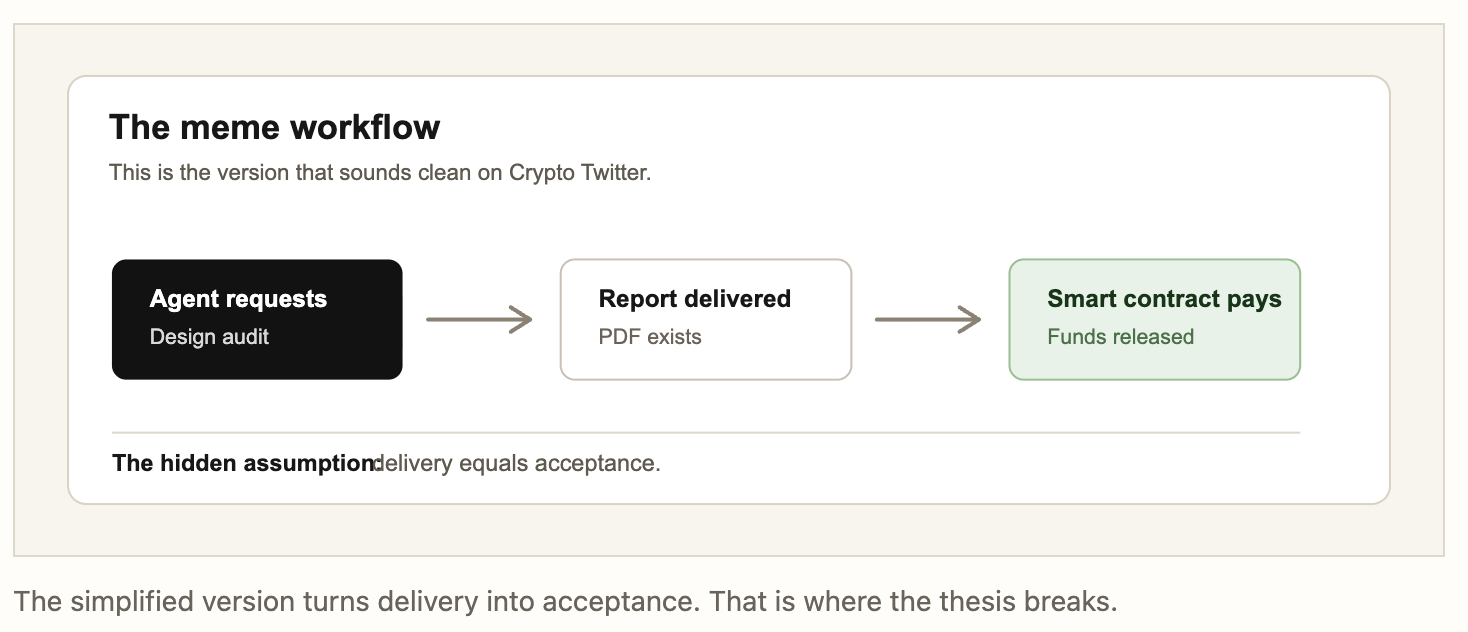
In the real world, the buyer might say: you missed the mobile flow, ignored checkout, and gave generic feedback. The seller might say the report was delivered, the buyer wants a revision, and the seller wants the funds released.
The disagreement is the point. Report delivered is not the same as work accepted.
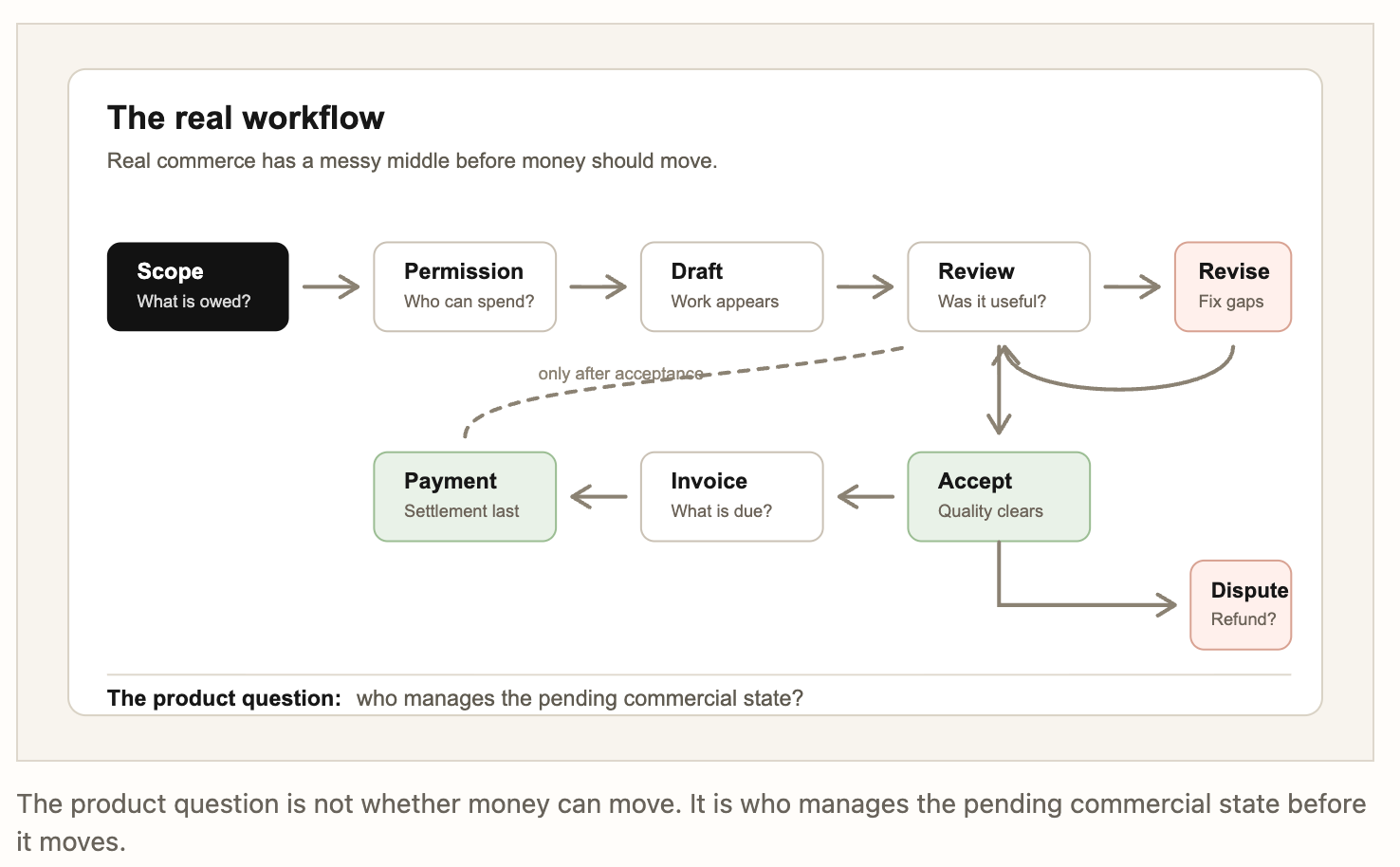
Payments are not money movement alone. They sit on top of scope, authority, terms, proof of work, and acceptance. They also need revision rights, dispute handling, refunds, and accounting.
The money moves at the end because something was agreed, delivered, reviewed, and accepted. Blockchains are good at final settlement, which is useful. But final settlement is only one piece of the payment stack.
Agent commerce does not need wallets first; it needs invoices.
A wallet can send money, but an invoice says what the money is for.
A transaction hash can prove funds moved; a receipt says what was delivered.
A smart contract can release payment when a condition is met. A commercial workflow decides whether the condition should count.
This matters because smart contracts are strongest when the world can be reduced to a clean state change. Did the buyer pay and did the seller submit work? Did the price hit X and did the asset move from A to B?
But most work is not that clean.
A design audit is not complete because a PDF exists. A code review is not complete because comments were posted. A market research task is not complete because a summary was generated.
The buyer cares whether the work matched the brief, found the important issues, and improved the decision.
Current chains are weak here, not because chains are useless. They are weak because they are built around finality, and a lot of commerce needs the opposite: unresolved state.
Real agent commerce needs states like requested, scoped, delivered, under review, revision requested, accepted, disputed, partially paid, and refunded. That middle layer is exactly what the narrative skips.
The bull objection is fair: smart contracts will evolve, chains will get faster, and account abstraction will improve. Agents will not manually bridge assets and estimate gas forever.
Agreed, but that is the future product claim, not the current narrative claim.
Today, most agent-payment pitches are selling settlement before proving the workflow. They say agents need to pay each other. They do not show how agents manage acceptance, revision, proof, refund, and dispute.
The test should be simple and concrete.
Can the system connect to real tools like Figma, GitHub, Linear, support tickets, or crawlers?
Can the buyer agent give scoped authority: spend up to $100, only on this task, only with this vendor? Can it require approval above a threshold and revoke access instantly?
Can the transaction stay unresolved while quality is reviewed? Can the system handle partial acceptance, a bad report, a missed requirement, a refund, or a dispute?
Can the user avoid thinking about gas, chain choice, bridging, failed transactions, and wallet operations?
And most important: is there recurring usage from real machine buyers? Or is the activity just token incentives pretending to be demand?
That is the line. We are not saying blockchains cannot power agent commerce. Neutral settlement may matter when agents transact across platforms, jurisdictions, and counterparties that do not trust each other. Some cases will need a ledger no single platform controls.
But “agents need wallets” is not enough. The scarce layer may not be the wallet. It may be the commercial wrapper around the wallet: invoice, permission, proof, review, dispute, refund.
Crypto Twitter can still trade the narrative. Narratives pay before products prove themselves. That is part of the game. Just do not confuse the trade with the truth.
Buy agent commerce chains if you want to buy the story.
Do not underwrite them as product-market fit yet. Wait until you see agents buying real services through a workflow that can handle the messy middle. Settlement is the last step; commerce is everything before it.